
Tractor unit with semi‑trailer
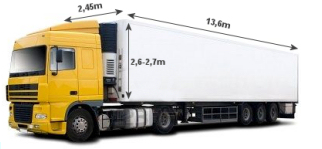
The semi‑trailer can hold 33 euro pallets or 26 UK pallets.
Volume 90 m³
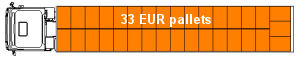
Best suited for transporting palletised goods.
Loading is possible from the rear, side and top.
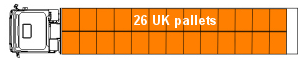
Volume 90 m³
Best suited for transporting palletised goods.
Loading is possible from the rear, side and top.
When is a semi‑trailer useful?
- You have palletised goods such as food products, beverages, building materials or packaged goods.
- You need a simple configuration that fits a loading dock and is easy to maneuver.
- You want flexibility in loading: from the rear, side or through the roof.
Think about these factors
- If you need to transport very heavy goods, the semi‑trailer can handle dense loads but might be limited if the goods are bulky.
- Check whether the loading area allows access from the side or the top; otherwise you will load only from the rear.
Truck with tandem trailer
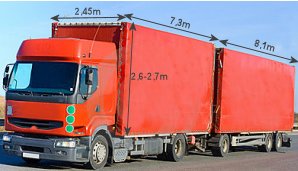
Tandem truck with two cargo sections.
- The lengths of the sections are 7.3 + 8.1 m (may vary).
- The maximum permitted total length of both trailers is 15.65 m.
- Maximum permitted load capacity 22 000 kg.
- Total volume 110–120 m³.
- A tandem can load 38 euro pallets or 30 UK pallets.

It is best suited for transporting large but light goods (pillows, quilts, soft wool, furniture, etc.).

The cargo can be loaded from the rear, side and top.
Why choose a tandem?
- Ideal for large but light goods such as pillows, quilts, soft wool and furniture.
- The two compartments allow better organisation or separation of goods.
- Loading can be done from the rear, side or roof.
Questions to ask yourself
- Will you fill both compartments? A tandem is efficient when you can split the load.
- Are there weight restrictions on your route? Although the volume is high, the legal limit of 22 tonnes remains.
Tractor unit with jumbo trailer
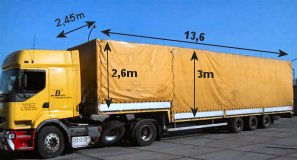
Articulated vehicle with a jumbo trailer.
- The dimensions of the jumbo trailer are 13.6 × 2.45 × 3 m.
- Maximum permitted load capacity 22 000 kg.
- The trailer can hold 33 euro pallets or 26 UK pallets.
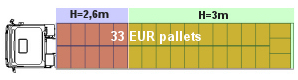
The trailer volume is about 96 m³.
Particularly suitable for light but bulky goods.
The goods can be loaded from the rear, side and top.
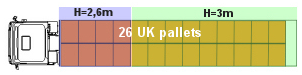
When to choose a jumbo trailer
- You transport light but bulky goods, such as empty bottles, insulation materials or light equipment.
- Your products need the extra height of 3 m.
- You want to load from the rear, side or roof.
Check the following
- Can the goods be stacked? Jumbo trailers make use of height; stacking goods uses space efficiently.
- Are there height restrictions on your route? Tunnels and bridges may impose limits, so check before departure.
Quick comparison
| Configuration | Number of euro pallets | Maximum weight (kg) | Approximate volume (m³) |
|---|---|---|---|
| Tractor unit + semi‑trailer | 33 | ≈22 000 | ≈90 |
| Truck + tandem trailer | 38 | ≈22 000 | 110–120 |
| Tractor unit + jumbo trailer | 33 | ≈22 000 | ≈96 |
How to choose the right configuration
When choosing, focus on the following criteria:
- Volume vs. weight: identify whether your goods are heavy or just bulky.
- Number of pallets: count how many pallets you need to move; decide whether one trailer is enough or you need the extra space of a tandem.
- Loading method: think about whether you can load from the side or top; tandem and jumbo setups offer flexibility, while a semi‑trailer may suffice when loading from the rear.
- Route restrictions: check legal limits on length and height on your planned route; tandem and jumbo vehicles may require additional permits.
By asking yourself these questions and comparing the size and weight of your cargo to the specifications above, you will choose the truck and trailer combination that best suits your needs.